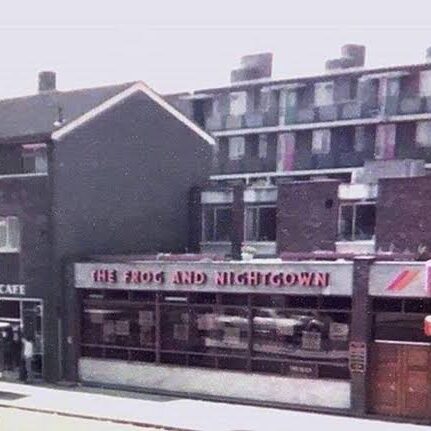
The forgotten Sunday sessions at the Frog and Nightgown and their place in the development of a distinctly British sound.
When people talk about the golden era of UK Garage, the conversation often starts with the late 1990s. The chart hits, the designer clothes, the champagne, the packed dancefloors and the unmistakable sound of 2-step.
But rewind a few years, before UK Garage became a mainstream phenomenon, and you’ll find part of its story unfolding somewhere considerably less glamorous.
A pub at 148 Old Kent Road in South London.
Its name? The Frog and Nightgown.
When Sunday morning became the main event
In the early 1990s, London’s underground dance music scene was changing.
American house and Garage records were finding enthusiastic audiences in British clubs, but a new culture was developing around what happened when Saturday night’s parties finished.
For some clubbers, going home wasn’t particularly appealing.
Instead, Sunday morning became an opportunity to keep dancing.
People leaving clubs such as Ministry of Sound would head towards smaller venues and pubs where the music continued long after the conventional clubbing hours.
The Frog and Nightgown became one of those destinations.
In an interview conducted by Bill Brewster and Frank Broughton, Timmi Magic of the Dreem Teem recalled the atmosphere of these early sessions. He remembered Matt Jam Lamont playing as a resident, alongside DJs including Mickey Simms and Dominic.
It wasn’t simply an extension of Saturday night. These gatherings were developing an identity of their own.
The music was changing, too
The records being played were heavily influenced by American house and Garage.
Producers and remixers such as Masters at Work, Roger Sanchez and others had already helped establish a sound built around soulful vocals, rolling percussion, deep basslines and infectious grooves.
But British DJs were approaching those records differently.
They were often drawn towards the instrumental and dub mixes, pushing the pitch and bringing a different energy to the dancefloor.
Timmi Magic recalled how these faster, heavier interpretations helped distinguish what was emerging in London from the American records that inspired it.
This wasn’t yet the two-step sound that would dominate the end of the decade.
It was an earlier stage in UK Garage’s development, when the relationship between US house, Garage, British club culture and homegrown production was still evolving.
And venues such as the Frog and Nightgown provided somewhere for that evolution to happen.
Mum’s The Word
One of the events associated with the Frog and Nightgown was Mum’s The Word.
Although its complete history remains difficult to reconstruct, surviving recordings offer a fascinating glimpse into the music played at the venue during the mid-1990s.
Recordings catalogued by The Beat Sanctuary include sets attributed to DJ Hermit on Boxing Day 1994, Dominic, Gerrad and Matt in February 1995, Norris Da Boss Windross in April 1995 and Jay Johnson in June 1995.
These recordings are particularly valuable because they allow us to hear something of the musical culture that existed before UK Garage’s commercial breakthrough.
They’re a reminder that music history doesn’t survive exclusively through commercially released records.
Sometimes it survives on a cassette recorded in a club, a flyer kept in a drawer or the memories of people who were there.
More than just a pub
The Frog and Nightgown wasn’t the only venue contributing to the emerging scene.
The Elephant and Castle pub, the Arches and other London spaces were part of a wider network of Sunday parties, DJs, promoters and audiences.
As that network grew, so did opportunities for British producers to create records specifically for these dancefloors.
The development of UK Garage wasn’t the result of one venue, one DJ or one record.
It was a gradual process shaped by people sharing music, experimenting with sound and building their own club culture.
But the Frog and Nightgown occupies an important place in that story.
It was one of the spaces where the music was being played, interpreted and embraced by an audience before much of the country even knew what UK Garage was.
Preserving the places behind the music
The original Frog and Nightgown building no longer stands.
Yet its contribution to London’s underground music history survives through interviews, recordings, flyers and personal recollections.
And perhaps that’s why stories like this matter.
When we document UK Garage, it’s easy to concentrate on the records that sold thousands of copies or the artists who appeared on television.
But the culture was built in places like this, too.
Small venues. Sunday morning gatherings. DJs experimenting with records. Crowds discovering something that felt like their own.
Before the chart success, before the superclubs and before UK Garage became a household name, there were places like the Frog and Nightgown.
And their stories deserve to be remembered.
Sources and further listening
- Bill Brewster and Frank Broughton, Dreem Teem on the Birth of UK Garage, Red Bull Music Academy Daily, 2018 (interview conducted in 2005).
- Beat Generation, The Observer, 2 July 2000.
- The Frog and Nightgown, Old Kent Road, Mum’s The Word, The Beat Sanctuary — surviving recordings attributed to the venue.
Were you at the Frog and Nightgown or Mum’s The Word?
If you have photographs, flyers, recordings or memories from those early sessions, we’d love to hear from you. Firsthand accounts are an invaluable part of preserving UK Garage history.
About The Author
